AI for Small Businesses: A Beginner’s Guide

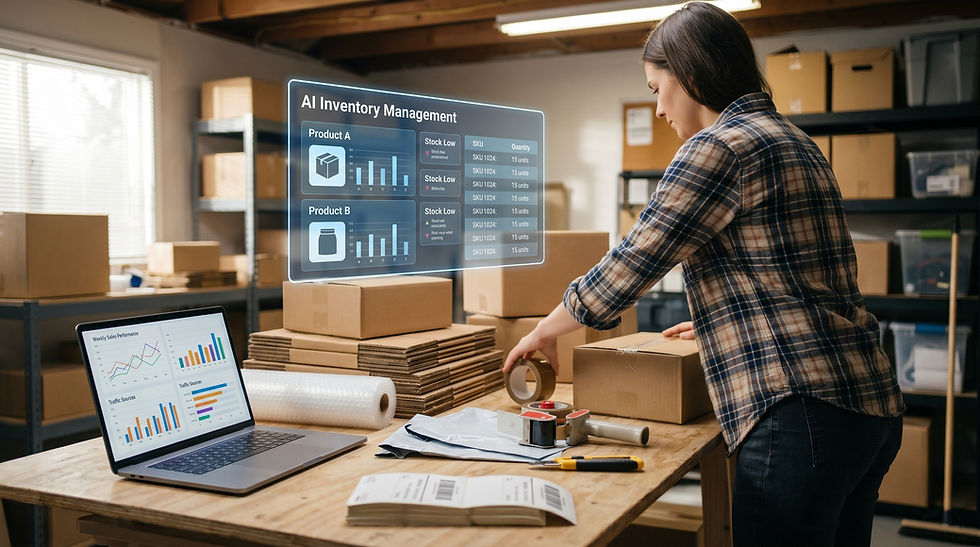
Artificial intelligence can sound like a major technology initiative, but its value for a small business often begins with something much simpler: reducing the time employees spend on repetitive work. Drafting emails, organizing information, answering routine customer questions, preparing reports, and reviewing data are all areas where AI can provide practical assistance.
Small businesses are already moving in this direction. According to the U.S. Chamber of Commerce's 2026 research, 66% of U.S. small businesses reported using AI, up from 58% in 2025 and 23% in 2023. That growth does not mean every business needs an extensive AI strategy immediately. It does show that AI is becoming part of the technology businesses use for everyday work.
Getting started does not require rebuilding the entire technology environment. The better approach is to understand what AI can do, identify a specific business problem, and determine whether the technology can improve that process without creating unnecessary complexity.
What Is AI for Small Business?
AI for small businesses refers to software that can perform tasks that typically require some level of human analysis, interpretation, or content creation. Depending on the application, AI can summarize information, recognize patterns, generate text, categorize data, answer questions, or trigger actions based on predefined conditions.
Generative AI is one part of that picture. It can produce text, images, summaries, and other content based on instructions. Other AI systems work behind the scenes, analyzing business information or identifying unusual activity.
Traditional automation usually follows a defined rule, such as sending an email when someone completes a form. AI can add another layer by interpreting the information within that process. A small business does not need to understand the technical mechanics behind every model, but it should understand what information the system uses and what business task it is expected to improve.
What Can AI Do for a Small Business?
The strongest AI use cases usually begin with work employees already perform. Instead of adding technology simply because AI is available, businesses can look for activities that consume time, depend on large amounts of information, or follow recognizable patterns.
Automate Repetitive Tasks
Administrative work can consume hours without necessarily requiring human judgment at every step. AI can assist with scheduling, document classification, meeting summaries, data entry, routine emails, and other repeatable activities. Combined with reliable managed IT services Ontario CA, these capabilities can become part of a broader technology environment rather than another isolated application.
The productivity potential can be meaningful when AI is applied to a defined workflow. Research published in 2025 in The Quarterly Journal of Economics examined 5,172 customer-support agents and found that access to a generative AI assistant increased issues resolved per hour by an average of 15%. The results varied by worker experience, reinforcing why businesses should evaluate AI against the specific process and people using it rather than assuming the same result everywhere.
Improve Customer Service
AI assistants can answer common questions, collect initial information, categorize requests, and direct more complicated issues to an employee. This can extend service availability while allowing people to concentrate on conversations that require context, judgment, or a personal response.
Support Marketing and Sales
Marketing teams can use AI to develop initial content drafts, summarize customer information, organize campaign ideas, and accelerate research. Sales teams can use it to prepare follow-ups, review account information, and identify patterns within customer activity. Human review remains important before content or recommendations reach customers.
Analyze Business Data
AI can help businesses work through information that might otherwise remain buried in spreadsheets, applications, and reports. It can summarize results, identify patterns, and make complex datasets easier to review. The effectiveness of these capabilities depends partly on how accessible and organized the underlying information is, making cloud solutions Ontario CA relevant when businesses are connecting applications, data, and workflows.
Increase Everyday Productivity
Employees can use AI to summarize lengthy documents, create first drafts, extract information, organize notes, and prepare presentations. The objective is not to remove human involvement. It is to reduce time spent preparing information so employees have more capacity for decisions and work that requires their expertise.
Where Should a Small Business Start With AI?
A successful first AI project does not need to involve every department. A narrower use case makes it easier to understand the results, identify problems, and decide whether further investment makes sense. Businesses can begin by examining existing processes before selecting a platform.
Start With a Business Problem, Not an AI Tool
Identify work that takes too much time, creates delays, or requires employees to repeat the same steps. Customer inquiries, manual reporting, sales follow-ups, appointment scheduling, and document processing are useful examples.
The question should be, "What process should we improve?" rather than, "Which AI tool should we buy?" Businesses that need help identifying those opportunities can use IT consulting services Ontario CA to evaluate where AI and automation make practical sense.
Choose One Low-Risk Use Case
Start with a process where mistakes can be identified before they create serious consequences. An internal meeting summary, for example, presents a different level of risk than an automated financial decision or customer-facing recommendation.
Look at the Technology You Already Use
Before purchasing another platform, review the software already in place. Existing productivity, CRM, cloud, and business applications may include AI capabilities that employees can test without creating an entirely separate workflow.
Test Before Expanding
A straightforward sequence keeps the project focused: identify the problem → test the use case → review the output → measure the result → expand when justified. This gives the business evidence before committing additional resources.
How to Choose the Right AI Tools for Your Small Business
The right tool is not necessarily the one with the longest feature list. It should solve a defined problem while fitting into the way employees already work.
Before adopting an AI platform, evaluate its ease of use, integration options, data requirements, privacy controls, cost, scalability, and human review capabilities. Determine which systems it needs to access and whether employees can use it consistently without creating extra manual steps.
Security should also be part of the evaluation. An application that produces useful results but requires inappropriate access to sensitive information may create more problems than it solves. The business case and technology requirements should therefore be considered together.
What Should Small Businesses Consider Before Using AI?
AI can increase productivity, but introducing it without clear boundaries can expose information or produce unreliable results. Businesses should establish basic expectations before employees begin using AI across everyday workflows.
Data Privacy and Security
Employees need clear guidance about what information can be entered into AI platforms. Customer records, financial information, credentials, proprietary documents, and employee data may require additional safeguards. Cybersecurity services Ontario CA can help businesses evaluate access, security controls, and compliance requirements as AI becomes connected to business systems.
AI Accuracy and Human Oversight
AI can generate convincing information that is incomplete or incorrect. Employees should verify important outputs, especially when information will guide decisions or be shared externally. Responsibility for the final decision should remain clearly assigned to a person.
Data Quality and Resilience
Poor information can produce poor results. Businesses should maintain accurate, organized data and understand where important information is stored. Protecting that information also matters. Backup and disaster recovery services Ontario CA can support the availability and recoverability of business data when systems are disrupted.
AI Governance
Even a small company can establish straightforward rules covering approved tools, restricted information, acceptable uses, employee responsibilities, and review requirements. These policies create consistency before AI usage expands across departments.
How to Measure Whether AI Is Actually Helping Your Business
AI adoption should produce an observable business improvement. Establishing a baseline before implementation makes it easier to determine whether the new process is actually better.
Business Area | What to Measure |
Productivity | Time spent on repetitive tasks |
Customer Service | Response and resolution times |
Sales | Follow-up time and conversion activity |
Marketing | Content preparation time and campaign results |
Operations | Manual steps, delays, and errors |
Cost | Expense before and after implementation |
The measurement should reflect the original problem. If AI was introduced to reduce reporting time, measure reporting time. If it was introduced to improve customer response, examine response speed and service quality. Usage alone does not demonstrate value.
When Does a Small Business Need Help Implementing AI?
Individual productivity tools may be relatively simple to test. Complexity increases when AI needs access to company data, connects several applications, automates an entire workflow, or handles information subject to security or compliance requirements.
Outside guidance may make sense when employees are independently adopting different tools, leadership cannot identify the right starting point, integrations involve multiple systems, or the business needs clear policies for data access and AI usage. At that stage, AI becomes less about experimenting with a feature and more about designing a dependable business process.
Start Small. Learn. Then Scale.
Small businesses do not need to automate everything to benefit from AI. A stronger starting point is one clearly defined problem, one controlled use case, and one measurable outcome. From there, the business can determine what worked, what needs adjustment, and whether the process deserves broader adoption.
If you are evaluating where AI and automation could fit into your operations, Contact Zeta Sky today to discuss your technology environment, business priorities, and opportunities for practical implementation.
Frequently Asked Questions
How Can Small Businesses Use AI?
Small businesses can use AI for administrative automation, customer service, marketing support, data analysis, document summarization, sales activities, and other repeatable processes.
What Are the Benefits of AI for Small Businesses?
AI can reduce repetitive work, accelerate access to information, improve response times, and give employees more time for activities that require experience and judgment.
What Tasks Can a Small Business Automate With AI?
Good candidates include scheduling, meeting summaries, document classification, routine communications, data organization, reporting, and initial customer request handling.
Do Small Businesses Need Technical Expertise to Use AI?
Not necessarily. Many business applications provide built-in AI capabilities. More technical expertise may be required when AI needs custom integrations, sensitive data access, automation across systems, or additional security controls.
Is AI Safe for Small Businesses?
AI can be used responsibly when businesses establish appropriate security, privacy, access, and review controls. Employees should also understand which information should never be submitted to unapproved AI applications.
How Should a Small Business Get Started With AI?
Begin with a specific business problem, select a manageable use case, define how success will be measured, test the process with human oversight, and expand only after the results demonstrate practical value.